24*7 365 days
24*7 365 days
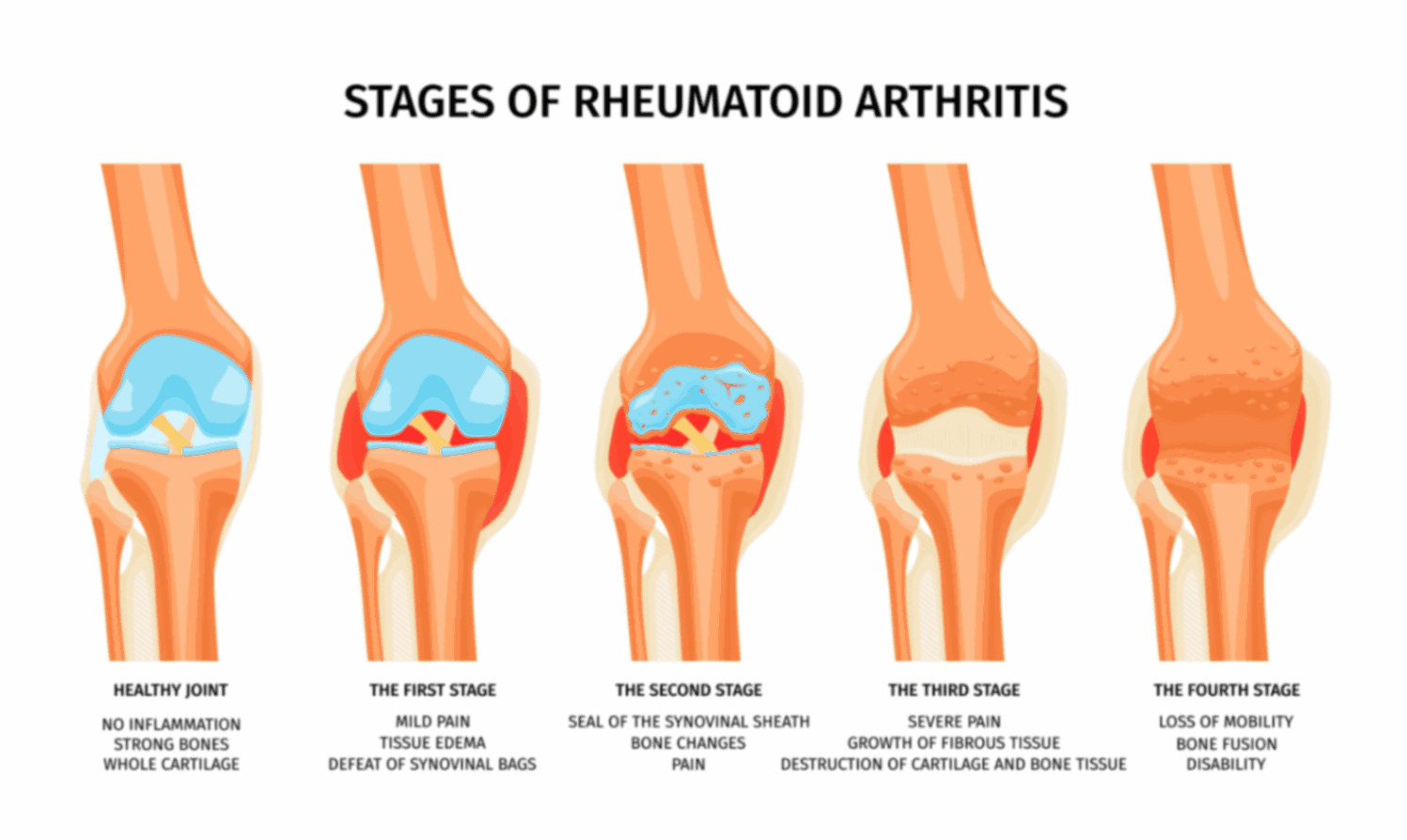
Rheumatoid arthritis is a chronic illness that primarily attacks the joints and can be gradually destructive when it is not treated promptly. Symptoms such as pain, swelling, and stiffness in the joints are first noticed by many people in the morning. With time, the condition may interfere with daily activities and complicate simple movements. Understanding the stages of rheumatoid arthritis can help people recognize early symptoms and seek treatment before the disease progresses.
This blog will discuss how rheumatoid arthritis progresses with time, the various stages of the illness, and the typical symptoms that manifest at each stage. We shall also address abnormal symptoms, treatment, and what might occur when the condition is not managed.
Rheumatoid arthritis (RA) is a chronic autoimmune disorder, primarily affecting the joints. In this state, the immune system wrongly attacks the lining of the joints, which is known as the synovium. This results in inflammation that results in pain, swelling, stiffness, and warmth in the affected joints. It is also common to find many individuals complaining that their joints are stiff in the mornings or after taking a rest.
In the long run, chronic inflammation may destroy cartilage and bones within the joint, which may influence the joint’s movement. Rheumatoid arthritis typically involves both sides of the body, including hands, wrists, knees, and feet. It is not the same as osteoarthritis, which occurs as a result of wear and tear, as rheumatoid arthritis occurs when the immune system targets normal joint tissue.
Rheumatoid arthritis typically progresses gradually, although the rate of disease progression may vary among individuals. It frequently starts with swelling of the lining of the joints, the synovium. This inflammation at an early stage is called synovitis. At this point, individuals can begin experiencing the pain, stiffness, swelling, and warmth of the joints, particularly in the morning or after rest.
Inflammation may destroy cartilage that cushions the joints as the disease progresses. The inflammation can also spread to the bones and other tissues nearby if it is not treated or controlled. This may cause long-term pain, stiffness, and damage of joints in the long run. In order to have a clearer picture of the development of the disease, physicians tend to categorize rheumatoid arthritis into four phases that demonstrate how the disease shifts between the initial inflammation and more severe damage of the joints.
Rheumatoid arthritis is normally classified by doctors into four stages depending on the extent to which the disease has advanced and the extent of destruction it has caused to the joints. These phases assist in understanding the progression of rheumatoid arthritis over time, including the initial inflammation to the joint destruction that is more severe. Knowledge of the stages may also assist physicians in selecting the appropriate treatment and controlling the symptoms more efficiently.
All the stages demonstrate various alterations in the joints and various symptoms that an individual might have. At the initial phase, the inflammation starts in the joint lining, but at a later stage, cartilage, bone damage, and loss of joint motion may be involved. The four stages of rheumatoid arthritis and the general occurrence in each stage are presented below.
This is the initial phase of rheumatoid arthritis. At this stage, the immune system begins to inflame the inner part of the joints, which is referred to as the synovium. The joints might appear normal externally, yet the inflammation within the joint might already start inducing pain and stiffness. In the majority of cases, individuals will begin to experience mild symptoms at this point, although irreversible joint damage is not normally present at this point.
Common symptoms include:
In most instances, the X-rays can still be normal since the bones and cartilage have not yet been destroyed. Nevertheless, the inflammation already exists within the joint. Early treatment at this level is highly significant since it may aid in trying to manage the inflammation and reducing the disease progression.
The second stage involves the inflammation within the joints developing to a stronger level and possibly the cartilage, which cushions the joints. Cartilage acts as a cushion between the bones; therefore, the joints may become painful and difficult to move when the cartilage begins to wear out. Numerous individuals observe that their symptoms are more evident at this stage.
Symptoms may include:
At this point, X-rays or scans can begin to reveal early joint damage. Symptoms tend to be observed in body parts such as hands, wrists, knees, and feet. The joint lining may also thicken and get inflamed, a condition referred to as rheumatoid synovitis.
By third stage, the disease has already advanced, and inflammation has already caused damage to the cartilage. Here, the joints may also start getting affected by the bones. Consequently, the joints may become weaker, painful, and stiffer to move. A great number of individuals begin to observe some evident alterations in the appearance and functionality of their joints.
The symptoms can be severe and can involve:
As an illustration, the hands can be affected such that people can observe bent fingers or poor grip strength. Rheumatoid arthritis can lead to pain during walking, swelling, and the instability of the joint when it attacks the knees. At this point, there is a likelihood of permanent joint damage if the disease is not well managed.
This is the most advanced stage of rheumatoid arthritis, where long-term inflammation has severely damaged the joints. The active inflammation can also be reduced in certain cases, yet the destruction of the joints can result in severe movement and daily activity issues.
Common problems include:
The joints can be extremely stiff, unsteady, or immobile. There is even the possibility of some of the joints fusing together. Due to the extent of the damage, many individuals might require interventions like joint replacement surgery to alleviate pain and enhance mobility. In extreme situations, long-term rheumatoid arthritis may also have an impact on the overall health and quality of life of a person.
Although the most common symptoms of rheumatoid arthritis are joint pain and swelling, there are other unanticipated symptoms of the disease. These do not have anything to do with the joints but may impact your general health.
These abnormal symptoms include some of:
Rheumatoid arthritis is an autoimmune disease, and hence may occasionally occur in other body parts, including the lungs, heart, skin, and eyes. Early detection of these symptoms can be used in the appropriate treatment and care.
Rheumatoid arthritis may develop extremely differently in different individuals. Others will have gradual changes over a long period of time, whereas others can suffer joint damage faster. The two initial years after symptom onset are often the most critical because much damage to the joints may be caused during this period if the disease is not treated.
Early diagnosis and treatment may be important. The treatment is able to assist in reducing the inflammation, supporting the joints, slowing down the disease and reducing the risk of long-term complications. Early care also helps in maintaining mobility and general quality of life.
Rheumatoid arthritis is not a disease that can be fully treated, but it can be controlled successfully. The goals of treatment are to minimize pain and inflammation, guard against the joints, and assist individuals to move and live their everyday existence more conveniently. Most individuals are able to live productive and healthy lives with the condition with appropriate drugs, lifestyle and medical care.
There is even the possibility of some patients going into remission, a condition where the symptoms are very mild or even disappear over a long period. The diagnosis and timely treatment are very crucial as they can prevent serious damage to the joints and enhance the outcome in the long-term. Although there is still no permanent cure, quality of life can be significantly improved, and people can be made self-sufficient through effective management.
Rheumatoid arthritis is treated depending on the disease stage and the severity of the symptoms. The early stage is aimed at the management of inflammation and prevention of joint destruction, whereas the later stages might need more aggressive methods, such as surgery. Physicians tend to develop an individual approach to each situation of each individual.
Treatment options are common, which include:
Medications:
Lifestyle changes:
Surgery (for advanced stages):
With a combination of medications, lifestyle modifications, and, in some cases, surgery, the majority of rheumatoid arthritis patients will be able to control their symptoms and preserve their joint functions, as well as to increase their quality of life.
Unless rheumatoid arthritis is treated, the inflammation in the joints may persist and slowly lead to severe injury. This may cause the joints to be permanently altered with time, making movement painful and difficult.
The potential complications are:
In the worst of cases, untreated rheumatoid arthritis may also predispose to serious health problems other than the joints. Early diagnosis and adequate treatment are highly essential to manage the inflammation and safeguard the joints as well as eliminate the long-term complications.
At Venus hospital, joint and autoimmune disease patients are attended to by well-experienced and highly qualified doctors who understand patients with rheumatoid arthritis well. The appropriate physician is capable of diagnosing the disease at an early stage, prescribing the most appropriate interventions, controlling the symptoms, and avoiding additional destruction of the joint. Through adequate counseling, the patients would be able to move better, experience less pain, and live a better life every day.

Dr. Samrat Shrestha is a competent general physician of Venus Hospital who has good experience in the treatment of rheumatoid arthritis and other autoimmune and chronic illnesses. In 2019 he graduated with his MD in Internal Medicine at the National Academy of Medical Sciences, Bir Hospital, with a specialization in rheumatic and musculoskeletal disorders.
He pays attention to the prevention of joint and autoimmune issues, effective treatment, and early diagnosis. He has a reputation of being careful, professional and able to offer personalized care to patients to relieve them of pain, preserve their joints and to enhance their general health. He is a reliable physician to handle rheumatoid arthritis and other related conditions due to his commitment to keeping abreast of the current medical developments.

Dr. Parimal Koirala is an extremely reputable general physician in the Venus Hospital and has a rich experience of diagnosing and treating various acute and chronic diseases. In 2016, he graduated with his MD in Internal Medicine at the National Academy of Medical Sciences, Kathmandu and also has fellowship training in echocardiography which provides him with a high level of heart assessment and early diagnosis of heart complications.
With more than ten years of experience, Koirala specializes in managing hypertension, diabetes, heart problems, respiratory and gastrointestinal conditions, and infections. He is recognized to have a solid evidence-based practice, composed demeanor, and accurate decision-making, which contribute to patient confidence and better outcomes. His hard work, professionalism, and zeal to advance his knowledge qualifies him to be a trusted and reliable doctor in the field of Internal Medicine.
Rheumatoid arthritis is a chronic autoimmune disorder that may gradually destroy the joints without treatment. The disease typically occurs in four phases; initially, mild inflammation, which may result in severe destruction of joints in the long run.
The awareness of the phases of rheumatoid arthritis can assist individuals in identifying the symptoms in the initial stages and seeking medical attention at an earlier stage. Correct treatment, medications, lifestyle changes, and in certain situations, surgery can enable many people to cope with the symptoms and maintain their joints, as well as to enjoy a better quality of life.
For specialized care, visiting a leading hospital in Kathmandu, such as Venus Hospital, can ensure timely diagnosis and expert treatment.
Rheumatoid arthritis occurs in four phases, which include early, moderate, severe, and end-stage. The stages demonstrate the progression of the disease between mild inflammation and severe joint destruction.
Rheumatoid arthritis in the hands is typically characterized by swelling and stiffness of the joints of the fingers. In the long run, it may lead to loss of grip strength, inability to move the fingers, and apparent deformities of the joints.
Seronegative RA is similar to regular RA, but it develops in individuals who are negative to some antibodies. The joints keep getting inflamed, the cartilage can get damaged, and over time, the joints may become deformed.
RA is a slow process in different individuals. There are those who might acquire joint damage gradually over a long period of time, and others can have the disease progress much faster in case it is not treated.